

 Evgenii Iudin
 Updated March 2026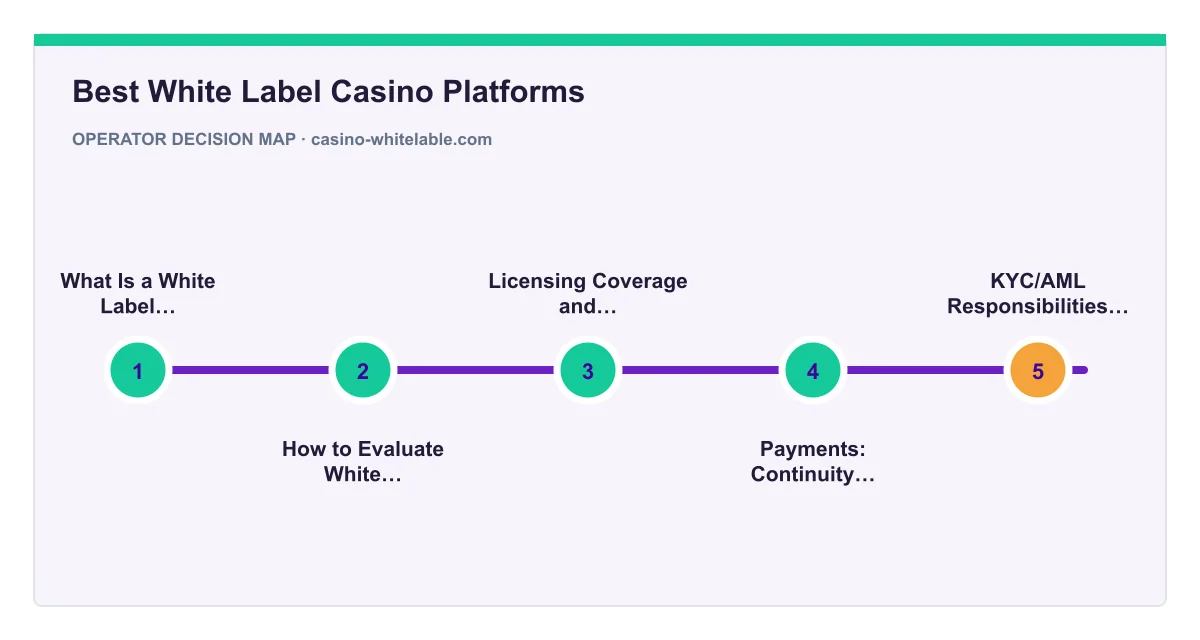
The iGaming market keeps expanding, and with it the number of teams trying to launch a casino brand quickly. A white label casino platform is often the fastest route because it provides a ready infrastructure: software, core integrations, back-office tools, and a licensing/compliance operating model. The trade-off is simple: you gain speed, but you must be much more disciplined in due diligence—especially around licensing scope, payment continuity, KYC/AML responsibilities, and data portability.
This guide explains how to evaluate white label casino platforms like an operator (not like a brochure): what a “platform” actually includes, which components create the biggest operational risk, and how to compare vendors using an evidence-based checklist and scorecard.
Compliance note: This page is informational and does not provide legal advice. Gambling regulation differs by jurisdiction; verify licensing, consumer protection, and responsible gambling requirements with qualified counsel in your target markets.
What Is a White Label Casino Platform
Definition: A white label casino platform is a fully operational iGaming stack provided by a vendor that enables an operator to launch a branded casino using the vendor’s software, integrations, and operating framework.
Why it matters: In white label, the most important question is not “how many games,” but who is responsible for what: licensing coverage, KYC/AML workflows, payment processing, player funds handling, and dispute handling all depend on the vendor’s structure and contract terms.
Most modern white label solutions include:
- Game aggregation (single integration to many game providers)
- Player Account Management (PAM) (accounts, wallets, sessions, history)
- Payments layer (PSPs, methods, payout orchestration)
- Compliance & risk tooling (KYC, AML monitoring, RG controls)
- Back office (bonuses, affiliates, reporting, segmentation)
- Support & operations (SLA, incident response, account setup)
What “white label” usually includes (and what it often does not)
- Usually included: brand front-end, back office access, basic CRM/bonuses, initial integrations, standard reporting, baseline compliance tooling.
- Often not included by default: bespoke UX/product work, custom payment routing per country, advanced fraud/chargeback strategy, local legal support, and truly portable data exports.
If you want a broader conceptual overview, see our guide to
what is a white label casino.
How to Evaluate White Label Casino Platforms
White label platforms can look identical on the surface. Operators should evaluate them by risk: what can stop you from operating, paying players, and staying compliant when conditions change.
Licensing Coverage and Operating Model
Licensing defines which markets you can realistically serve, which payment routes are viable, and which compliance processes must exist in the product.
- Who holds the license? (provider, master licensee, or your entity)
- What’s covered? casino only vs sportsbook, live casino, bingo, crypto, etc.
- Market restrictions: excluded countries, local advertising limits, RTP rules, bonus limits
- Responsible gambling tooling: deposit limits, self-exclusion, reality checks, cooling-off
- Reporting obligations: regulator reports, audit logs, transaction traceability
Payments: Continuity and Withdrawal Reliability
Payments are the #1 operational risk in iGaming. A platform is only as stable as its payment rails and payout speed.
- PSP redundancy: can you switch providers without downtime?
- Merchant of record: who is legally processing player payments?
- Payout workflow: manual vs automated, approval layers, fraud checks, SLA for withdrawals
- Chargebacks & disputes: who handles them and who carries the loss?
- Local methods: cards, bank transfer, e-wallets, vouchers, alternative rails by GEO
KYC/AML Responsibilities and Risk Controls
Many operators underestimate compliance scope in white label. Your risk depends on how identity verification, transaction monitoring, and escalation are implemented.
- KYC vendor: which provider is used, and can you change it later?
- Triggers: what events force verification (thresholds, velocity, suspicious patterns)?
- AML monitoring: rules engine vs manual review, alert volume, analyst tooling
- Player funds and segregation: how balances are stored and reconciled
Player Account Management (PAM) and Data Portability
Your PAM determines whether you can run stable operations and whether you can ever migrate away.
- Wallet model: single wallet vs multi-wallet, bonus wallet behavior, session handling
- Auditability: immutable logs for critical actions (KYC, payouts, bonus changes)
- Exports: what you can export (players, balances, transactions, game history, KYC docs)
- Exit plan: data format, timing, fees, and whether the vendor can restrict migration
Game Provider Portfolio and Aggregation Quality
If you need deeper integration context, see
casino API integration.
- Portfolio fit: do providers match your GEO and player preferences?
- RTP and jurisdiction controls: can you enforce market-specific configurations?
- Game ops: handling of outages, game certification, and provider disputes
- Aggregation reliability: latency, rounds reconciliation, rollback handling
Operator Scorecard
Use the scorecard below to compare vendors consistently. The goal is to reduce “sales-demo bias” and quantify operational risk.
| Category | What to verify | Suggested Weight |
|---|---|---|
| Licensing | Coverage, restrictions, RG requirements | 25% |
| Payments | PSP redundancy, withdrawal workflow | 20% |
| Compliance | KYC/AML monitoring | 15% |
| PAM | Wallet stability and controls | 15% |
| Games | Provider mix and integration quality | 15% |
| Operations | SLA, incident handling, support model | 10% |
Minimum due diligence checklist (fast filter)
- Contract clarity: responsibilities for KYC/AML, player funds, disputes, and reporting are explicit.
- Payment continuity plan: at least one backup PSP route exists for your key markets.
- Data export + exit: defined export formats + timeline, including transaction history and audit logs.
- Responsible gambling: controls exist and are configurable per jurisdiction.
- Uptime & incident response: measurable SLAs, escalation contacts, and post-mortem process.
White Label vs Custom Casino Platforms
White label optimizes for speed and reduced build effort. Custom development optimizes for control and differentiation.
| Factor | White Label | Custom |
|---|---|---|
| Time to launch | Fast (weeks) | Slow (months+) |
| Control | Limited (depends on vendor) | High |
| Compliance burden | Shared / bundled | Mostly on operator |
| Portability | Often constrained | Higher (if designed) |
| Long-term costs | Revenue share / fees | Build + ongoing ops |
For more context on the broader stack, see our article on
iGaming platform architecture.
Related Reading
casino software
white label casino solutions
mobile casino platform
turnkey casino solution
FAQ
What is the best white label casino platform?
The best white label casino platform is the one that matches your target markets and minimizes operational risk.
How long does it take to launch a white label casino?
Many launches happen within a few weeks when integrations are pre-built.
Do white label casinos require a gambling license?
White label operations usually rely on a licensing structure provided by the platform provider, but the exact setup depends on jurisdiction and contract terms.
Is it possible to migrate away from a white label platform later?
Yes, but migration depends on data portability, wallet and transaction exports, and the vendor’s exit process. Confirm export formats, timelines, and fees before signing.
