

 Evgenii Iudin
 Updated March 2026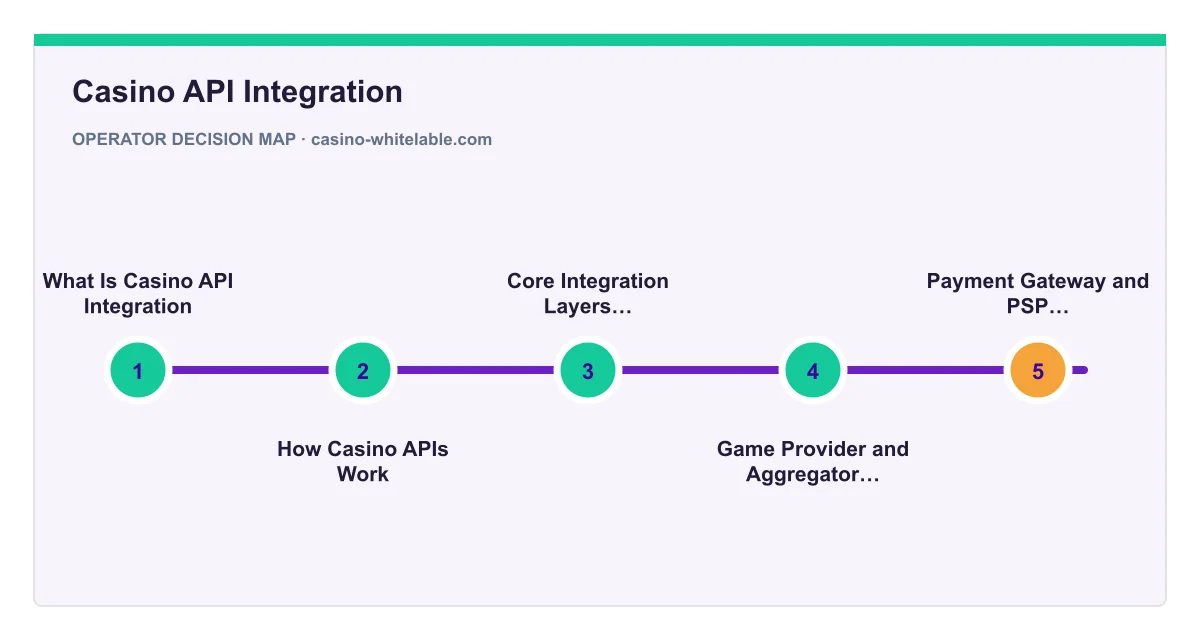
Definition: Casino API integration is the process of connecting an online casino platform to external services—such as game providers, payment systems, identity verification, and risk tools—through application programming interfaces (APIs). APIs define how systems exchange data and execute actions (for example: launching a game session, authorizing a deposit, or validating a withdrawal check) in a controlled and auditable way.
Last updated: March 8, 2026
Written by: iGaming Research Team
Reviewed by: Compliance Editor (Platform Infrastructure & Integrations)
Note: This page is informational. Integration requirements vary by jurisdiction, provider policies, and platform architecture. Operators should confirm licensing, payments, and responsible gambling obligations with qualified compliance and legal advisors and ensure technical controls are contractually defined with vendors.
What Is Casino API Integration
Casino API integration is the technical work of connecting third-party services to a casino platform through standardized interfaces so that systems can exchange requests, responses, and event data automatically. Instead of building every capability in-house, operators integrate external components that specialize in specific functions.
Common API-integrated categories include:
- Game content: game studios and aggregators that deliver slots, table games, and live dealer content.
- Payments: PSPs, payment gateways, and banking rails used for deposits and withdrawals.
- Player verification: identity, age, and document verification systems (KYC) where required.
- Risk and fraud: tools that detect suspicious account behavior, transaction anomalies, and bonus abuse patterns.
- Responsible gambling: self-exclusion, limits, reality checks, and player protection workflows.
- Analytics and reporting: event pipelines, dashboards, and exports for operations and compliance reviews.
APIs are a foundational part of modern casino software architecture and are used in both proprietary platforms and white label casino software solutions.
How Casino APIs Work
Casino APIs act as structured protocols: they define endpoint routes, authentication methods, request/response formats, error codes, and event callbacks (webhooks). In a typical architecture, the casino platform sends API requests when a player performs an action, and external services respond with an outcome that the platform must record consistently.
Examples of common API-triggered actions include:
- launching a game session
- placing a wager / submitting a bet request
- authorizing a deposit
- initiating and confirming a withdrawal
- checking account balance and bonus eligibility
- verifying player identity and risk status
Reliable API behavior is critical because casino operations depend on real-time synchronization between systems. A well-designed integration should be resilient to downtime, support idempotency (safe retries), provide clear error handling, and generate audit-ready logs.
| API Function | Purpose | Typical Reliability Need |
|---|---|---|
| Game Launch API | Creates a session and loads a game from a studio or aggregator | High (player experience + session integrity) |
| Wallet / Transaction API | Updates balances, records wagers, credits wins, reconciles transactions | Critical (money movement + accounting) |
| Payments API | Authorizes deposits and executes withdrawals via PSP/gateway | Critical (financial + compliance) |
| Account / PAM API | Manages player profiles, authentication, account status, limits | High (access control + policy enforcement) |
| Security / Risk API | Fraud scoring, identity checks, AML monitoring triggers | High (loss prevention + regulatory risk) |
Core Integration Layers in a Casino Platform
1) Game Provider and Aggregator APIs
Game provider APIs connect the casino platform to external studios or aggregators. In many models the casino does not host games locally; instead, it requests a session and loads a provider-hosted client. The integration must ensure session integrity, consistent wallet debits/credits, and correct handling of errors (for example: timeouts or interrupted sessions).
When evaluating content integrations, operators should confirm:
- Jurisdiction availability: whether specific games are allowed and supported in target markets.
- Certification status: where required, that content meets local certification expectations.
- Reporting depth: game-level performance, RTP reporting (where applicable), and troubleshooting logs.
- Operational process: how new studios are added, removed, or restricted by country.
Most ecosystems include multiple casino game providers and may use aggregation to reduce the number of direct integrations.
2) Payment Gateway and PSP APIs
Payment APIs enable deposits and withdrawals through PSPs and payment gateways. These integrations typically handle authorization, status callbacks, reconciliation reporting, and exception handling (failed deposits, reversed transactions, or payout holds).
Because payments are a high-risk domain, operators should treat payment integration as both a technical and compliance process, not just a “connect-and-go” feature. Settlement terms, chargeback exposure, fraud controls, and jurisdictional restrictions can vary significantly by provider.
Payments often operate within broader platform infrastructure, including white label casino models where the provider supplies parts of the payments stack but the operator remains responsible for operational outcomes.
3) Player Account Management (PAM) and Wallet APIs
Player Account Management (PAM) APIs maintain core player state: profiles, authentication, account status, limits, wallet balances, and transaction history. PAM and wallet layers must remain consistent across game activity, payments flows, and bonus logic.
Key PAM/wallet functions commonly include:
- registration and authentication events
- account status and restriction controls
- wallet balance and ledger updates
- bonus eligibility and bonus wagering state
- session history and transaction reporting
4) Security, KYC/AML, and Responsible Gambling APIs
Security and compliance integrations help enforce platform policies and jurisdictional rules. Casino platforms may connect to external services for identity verification (KYC), fraud prevention, transaction monitoring (AML controls where required), and responsible gambling tooling.
Common API-integrated controls include:
- KYC verification: identity and age verification workflows and re-check triggers.
- Fraud monitoring: anomaly detection for account access, payments behavior, and bonus abuse.
- AML-related monitoring: transaction pattern alerts and escalation workflows (jurisdiction-dependent).
- Responsible gambling: limits, self-exclusion, reality checks, and player protection workflows.
Because regulatory standards differ across jurisdictions, operators should confirm that integrations support the specific policy requirements of their target markets and that enforcement ownership is clearly defined.
Integration Reliability: What “Good” Looks Like
For casino operations, “API works” is not enough. Mature integrations typically include operational safeguards that protect money movement, player state, and auditability.
- Idempotency: safe retries for transaction actions to prevent double debits/credits.
- Clear error handling: standardized error codes and fallback flows for timeouts or partial failures.
- Webhook integrity: signed callbacks and replay protection for status updates.
- Audit logs: traceable records linking player actions, requests, responses, and final outcomes.
- SLA and monitoring: uptime targets, alerting, and incident response procedures.
Payments Due Diligence Checklist (Questions to Ask)
Payment integrations are one of the most common sources of operational and compliance risk. Before selecting a payments stack (directly or via a platform provider), clarify risk ownership and failure handling.
- Merchant structure: Who is the merchant of record and who owns chargeback/dispute liability?
- Settlement terms: What are payout schedules, rolling reserves, and minimum settlement thresholds?
- Jurisdiction coverage: Which countries/currencies are supported and what restrictions apply?
- Withdrawal controls: What triggers additional checks and how are payout holds handled?
- Fraud tooling: What signals are used (device, velocity, behavior) and how are decisions audited?
- Reconciliation exports: What reports exist for finance, compliance, and dispute workflows?
- Redundancy: Are there backup PSPs or alternative rails if one partner terminates service?
- Operational responsibilities: Who manages support tickets, refunds, reversals, and chargeback evidence?
- Security: How are API keys stored/rotated and how are callbacks verified?
API Integration in White Label Casino Platforms
In many white label casino software models, a significant part of the API ecosystem is already integrated: game aggregation, some payment connectivity, and parts of KYC or risk tooling may be included by default. This can reduce technical workload for new operators.
However, white label does not automatically guarantee fit for a specific market. Operators may still need to add integrations for local PSPs, jurisdiction-specific verification tools, or responsible gambling systems, and should confirm which integrations are truly included versus “available on request.”
Choosing the Right Casino API Solution
Selecting integrations should prioritize operational stability, auditability, and jurisdictional fit over simple feature lists. Key factors to evaluate include:
- Reliability and uptime: published SLAs, monitoring, and incident response processes.
- Security standards: authentication methods, encryption, key rotation, and webhook verification.
- Documentation quality: integration guides, error codes, sandbox support, and versioning policy.
- Compatibility: whether the integration matches your platform architecture and wallet model.
- Compliance alignment: support for jurisdictional requirements and enforceable audit trails.
- Support model: escalation paths, response times, and change management for breaking updates.
Well-designed APIs allow casino platforms to expand functionality while maintaining stability and consistent player experience.
Red Flags (Common Integration Risks)
- No clear strategy for idempotency and retry-safe transaction handling.
- Unclear audit logging or inability to trace disputes to request/response pairs.
- Webhook callbacks without signing/verification and replay protection.
- Vague answers about payments liability, dispute workflows, and settlement terms.
- Integrations that require frequent manual intervention to reconcile balances or sessions.
Final Thoughts
Casino API integration is a core requirement for modern iGaming operations because it connects games, payments, security controls, and player account infrastructure into one platform. Strong integrations are not only about connectivity—they are about reliability, transaction integrity, auditability, and enforceable operational responsibilities.
For operators and teams entering the industry, understanding the integration landscape helps reduce launch risk and improves long-term stability, especially in payments, compliance tooling, and data governance.
FAQ
What is a casino API?
A casino API is a software interface that allows a casino platform to communicate with external services such as game providers, payment processors, verification tools, and risk systems.
Why are APIs important for online casinos?
APIs enable real-time system communication so platforms can synchronize game sessions, wallet updates, deposits/withdrawals, and security checks across multiple vendors.
Do white label casinos use API integrations?
Yes. Most white label casino platforms include pre-configured API integrations with game aggregators, payment connectivity, and operational tools. Operators may still add local or jurisdiction-specific integrations as needed.
What is the biggest risk area in casino API integration?
Payments and wallet integrity are often the highest-risk areas because they involve money movement, dispute exposure, fraud controls, and audit requirements. Operators should confirm responsibility split, settlement rules, and transaction logging before launch.
