

 Evgenii Iudin
 Updated March 2026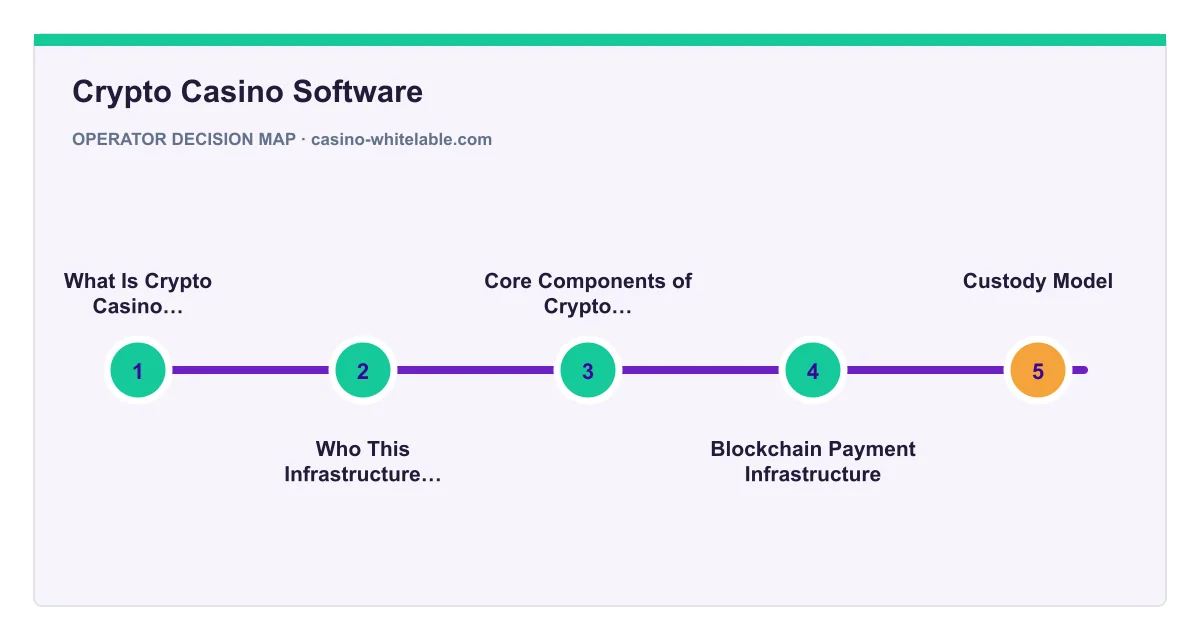
Scope: This page explains the technology infrastructure used to build cryptocurrency-enabled iGaming platforms, including software architecture, security, and compliance capabilities. It is not legal, financial, or gambling advice.
Author: Casino WhiteLabel Editorial Team
iGaming Platform Analysts (payments, game aggregation, platform security, and compliance requirements)
Publisher: Casino WhiteLabel — provider of white label casino platforms and iGaming software solutions.
Editorial policy: We describe standard industry components and controls such as security, AML/KYC, and payments, distinguish between essential controls and optional features, and refer to primary regulators and standards where relevant.
Last reviewed: 2026-03-10 (requirements vary by jurisdiction and license).
What Is Crypto Casino Software
Crypto casino software is a specialized iGaming technology stack that enables an online gambling platform to accept cryptocurrency deposits and withdrawals and manage gameplay through an internal balance system, while meeting licensing, AML/KYC, and security requirements relevant to the operator’s jurisdiction.
In practice, it combines: (1) blockchain payment infrastructure, (2) game aggregation and session management, (3) a player account and wallet ledger, (4) risk, fraud, and compliance tooling, and (5) reporting for operations and regulators.
Who This Infrastructure Is For
- Licensed operators that want to add crypto payment rails without rebuilding the entire casino platform.
- Startups entering regulated markets that need AML/KYC, limits, and audit-ready reporting from day one.
- Brands in emerging markets where card processing is limited, but stablecoins and on-chain payments are common.
Many businesses use ready-made infrastructure through a white label casino solution, which typically includes game integrations, back office, payment modules, responsible gambling tools, and compliance options.
Core Components of Crypto Casino Software
A professional crypto casino platform is not simply “a casino + crypto deposits”. It requires a complete ecosystem that ties blockchain transactions to a controlled internal ledger, game sessions, user identity checks where required, and financial reporting.
1) Blockchain Payment Infrastructure
The payment layer enables users to deposit and withdraw cryptocurrencies through integrated wallets and monitoring systems. Operators typically support multiple networks such as Bitcoin, Ethereum, and TRON, as well as stablecoins.
- Multi-currency wallets (hot and cold wallet separation)
- Address management (per-user addresses or payment invoices)
- Transaction monitoring (confirmations, reorganization handling, and stuck transaction detection)
- Withdrawal controls (limits, approvals, and velocity checks)
- Optional smart contract flows for certain products where applicable
Custody Model
Custody design directly affects operational risk, reconciliation, and compliance workflows. The main approaches differ in who controls the wallets and how treasury funds are separated.
| Model | What It Means | Typical Risks | Typical Controls |
|---|---|---|---|
| Operator-custodied | Casino controls wallets; players deposit to platform addresses | Hot wallet compromise; operational errors | Cold storage, multisig, withdrawal approvals, monitoring |
| Third-party custodian | Wallet custody is outsourced to a regulated or enterprise provider | Vendor dependency; integration failures | SLA, audits, incident playbooks, redundancy |
| Hybrid | Operator holds some assets; custodian holds treasury funds | Complexity; misconfiguration | Clear segregation, automated reconciliation, role-based access |
2) Gaming Content and Providers
Crypto casinos usually integrate slots, live dealer tables, and instant games through aggregation. The platform should provide a unified API layer that handles game catalogs, session tokens, and wallet callbacks.
Game distribution is often handled through casino software systems that aggregate providers and manage game libraries.
3) Player Management and Wallet Ledger
The player module controls authentication, balances, bonuses, responsible gambling settings, and self-exclusion where required. In crypto platforms, the system usually maps on-chain deposits to an internal ledger balance to keep gameplay fast and consistent.
Responsible Gambling Requirements
- Deposit, loss, and session limits
- Cooling-off periods and self-exclusion flows
- Reality checks and session reminders
- Age verification and identity checks where required by license
4) Risk, Fraud, and AML/KYC Controls
Crypto reduces chargeback risk but increases exposure to illicit flow risks, sanctions risk, and account takeover attempts. A production-grade platform typically includes AML/KYC workflows, wallet screening options, and auditable logs.
- KYC identity verification modules with configurable thresholds
- AML monitoring for transaction patterns, velocity, and linked accounts
- Wallet risk screening through optional third-party integrations
- Audit trails for operator actions in the admin panel, payments, and bonuses
Note: the exact requirements depend on the operator’s license and jurisdiction. Avoid one-size-fits-all claims.
Advantages of Crypto Casino Platforms
Operators adopt cryptocurrency payment rails for speed, global reach, and alternative payment access. The operational benefit exists only if security, reconciliation, and compliance are implemented correctly.
| Feature | Traditional Casino | Crypto Casino |
|---|---|---|
| Payment processing | Banking gateways | Blockchain transactions plus an internal ledger |
| Transaction speed | Minutes or hours | Seconds to minutes, depending on the network |
| Global access | Limited by banking systems | Broader reach, still limited by licensing |
| Transaction fees | Higher processing costs | Network fees vary; stablecoins often reduce friction |
| Privacy | Full identity verification | Identity requirements depend on jurisdiction and risk thresholds |
Popular Cryptocurrencies Used in Online Casinos
Most platforms support a mix of major assets and stablecoins to balance user demand and volatility risk.
- Bitcoin (BTC)
- Ethereum (ETH)
- Tether (USDT)
- Litecoin (LTC)
- TRON (TRX)
- Binance Coin (BNB)
Why stablecoins matter: stablecoins such as USDT reduce volatility exposure for both players and operators while preserving the operational benefits of blockchain settlement.
How Crypto Casino Software Integrates With Gaming Systems
Most crypto casinos use an API-based architecture that connects wallets, the internal ledger, game providers, and the operator dashboard. The goal is deterministic accounting: every bet, win, and adjustment must reconcile to the ledger and, where applicable, to on-chain flows.
Modern platforms rely on casino API integration to manage game distribution, player sessions, and financial transactions across multiple modules.
Integration Architecture
- Deposit: the player sends crypto to a provided address or invoice.
- Confirmation: the system detects confirmations and performs risk checks according to the license.
- Ledger credit: the platform credits the internal balance and records the event in the audit log.
- Gameplay: game providers debit and credit the ledger through wallet callbacks.
- Withdrawal: the player requests a payout; the platform applies limits, approvals, and monitoring before broadcasting the transaction.
Security Requirements for Crypto Gambling Platforms
Security is critical because blockchain transactions are typically irreversible. A secure setup is defined by segregation of funds, strict access control, monitoring, and incident readiness.
Minimum Security Checklist
- Cold storage for treasury funds and minimal hot wallet exposure
- Multisig and role-based approvals for withdrawals
- 2FA for player and admin accounts; hardware keys for privileged roles where possible
- Encryption for sensitive data at rest and in transit
- WAF and DDoS protection with bot mitigation
- Immutable audit logs for admin actions and financial operations
- Regular security testing including SAST, DAST, and penetration tests
Compliance Capabilities
A professional iGaming platform commonly includes options for KYC verification, AML monitoring, and responsible gambling controls. However, compliance-ready infrastructure is not a guarantee of compliance — operators must configure controls according to their license and risk model.
Provably Fair and Game Integrity
Provably fair is a cryptographic method that allows players to verify that game outcomes were not manipulated. It typically uses a combination of server seed, client seed, and nonce to generate verifiable results.
What Provably Fair Does and Does Not Mean
- It helps verify certain game outcomes, mainly for RNG-based instant games.
- It does not replace licensing, certified RNG requirements, or provider compliance in regulated markets.
- It must be implemented transparently with a clear verification guide and disclosed parameters.
How to Launch a Crypto Casino
Launching requires a coordinated plan across licensing, payments, games, security, compliance, and operational readiness. A fast launch is only safe when controls are not sacrificed for speed.
Typical Launch Process
- Select a crypto-ready casino platform provider
- Choose target jurisdictions and obtain an appropriate gambling license
- Implement KYC/AML flows and responsible gambling tools according to licensing requirements
- Integrate cryptocurrency payment rails, wallets, or custody, and define limits and approvals
- Connect game providers and validate wallet callbacks and reconciliation
- Run security testing, incident drills, and accounting audits
- Launch marketing and affiliate programs with compliant messaging
Operational Metrics You Should Track From Day One
- Deposit and withdrawal conversion by currency and network
- Reconciliation delta between the ledger, provider reports, and on-chain records
- Fraud and AML alerts, plus resolution time
- Game session error rate and wallet callback failures
- Bonus abuse, multi-accounting attempts, and dispute-like cases
Future of Blockchain Gambling Technology
Adoption continues in markets where crypto payment rails reduce friction. The main direction of evolution is not simply adding more coins, but improving compliance tooling, custody safety, auditability, and integrity mechanisms such as provably fair systems where applicable.
Conclusion
Crypto casino software is the foundation of blockchain-enabled gambling platforms, combining wallets, internal ledger accounting, game aggregation, security controls, and compliance capabilities. The strongest platforms are defined by predictable accounting, incident resilience, and license-aligned controls — not only by the number of supported coins.
Disclaimer: This article is provided for informational purposes about software infrastructure. It does not constitute legal, tax, or financial advice. Gambling laws vary by jurisdiction, so operators should consult qualified counsel and their licensing authority.
Frequently Asked Questions
What is crypto casino software?
Crypto casino software is an iGaming platform stack that supports cryptocurrency deposits and withdrawals, maps on-chain payments to an internal balance ledger for gameplay, integrates game providers through APIs, and includes security and compliance capabilities required by the operator’s jurisdiction and license.
Which cryptocurrencies are most commonly used in online casinos?
Most platforms support a mix of BTC, ETH, and stablecoins such as USDT, plus networks like TRON and assets such as LTC and BNB. Stablecoins are widely used because they reduce volatility while preserving blockchain settlement benefits.
Is crypto gambling legal?
Legality depends on the jurisdiction and the applicable license. Some regulators treat crypto payments under existing gambling frameworks, while others require specific controls such as KYC, AML monitoring, limits, and reporting.
Do crypto casinos require KYC and AML controls?
In regulated markets, KYC and AML controls are typically required. Even outside strict regulatory environments, many operators use risk-based verification, transaction monitoring, and auditable logs to reduce fraud and illicit flow exposure.
What is the difference between an on-chain balance and an internal casino balance?
An on-chain balance exists on the blockchain and changes through network transactions. The internal casino balance is a platform ledger used for fast gameplay. Deposits are confirmed on-chain and then credited to the internal ledger, while withdrawals reverse that process.
