

 Evgenii Iudin
 Updated March 2026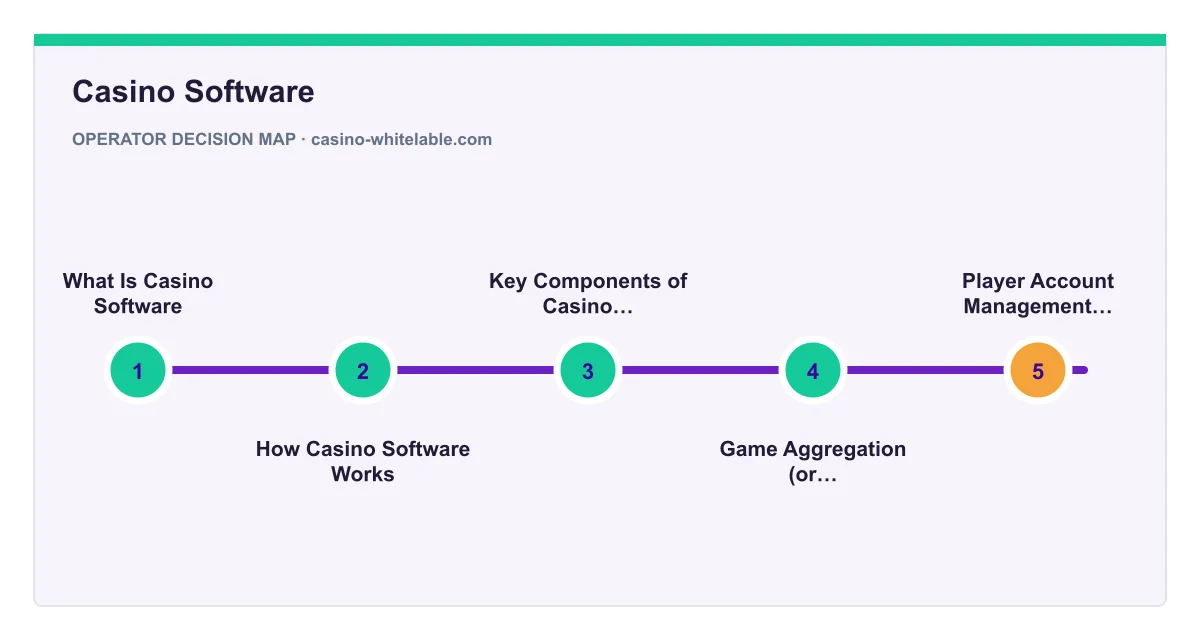
Definition: Casino software is the technology infrastructure that powers online casino operations. It includes systems for player accounts, game delivery and integration, payments, security controls, reporting, and back-office administration.
Scope note (YMYL): This page is for informational and technical overview purposes. It does not provide legal advice or guarantee regulatory compliance. Requirements differ by jurisdiction and operator business model; consult qualified legal and compliance professionals before launching or operating a gambling product.
Last updated: March 8, 2026
Written by: iGaming Research Team
Reviewed by: Compliance Editor (Payments & Platform Operations)
Modern online casinos rely on multi-module platforms to deliver games, manage player identity and wallets, process deposits and withdrawals, and maintain auditability. Most operators do not build these systems from scratch. Instead, they license or integrate established platforms (white label, turnkey, or custom) that already include the core operational components and vendor connectivity.
This guide explains what casino software is, which modules typically make up a production platform, where operational and compliance risks usually appear, and how to evaluate providers in a way that reduces launch and scaling friction.
What Is Casino Software
Casino software is the technical foundation behind an online gambling platform. It controls game content delivery, player identity and access, wallet and transaction flows, bonus logic, risk controls, and administrative operations.
What it includes: player account management (PAM), game aggregation or direct provider integrations, wallet and payment connectivity, bonus engine, reporting, audit logs, security controls, and operational dashboards.
What it is not: a gambling license, a legal compliance program, or a substitute for jurisdiction-specific regulatory approvals. A platform can support compliance (e.g., KYC/AML tooling), but the operator remains accountable for policies, monitoring, and controls.
Many new brands enter the market by launching a white label casino, which uses an existing platform infrastructure rather than developing a proprietary stack.
How Casino Software Works
A typical platform connects three layers into one operating environment:
- Content layer: game studios and live dealer providers delivered via aggregation or direct APIs.
- Operations layer: player accounts, wallet, bonuses, customer support tooling, and reporting.
- Risk & governance layer: security, access control, audit logs, KYC/AML integration, responsible gambling (RG) tools, and transaction monitoring.
Operators manage these layers through back-office dashboards. The most common operational flows include onboarding and verification (KYC), deposits and withdrawals via payment service providers (PSPs), gameplay events and wallet updates, bonus issuance and abuse controls, and monitoring/reporting for finance, risk, and compliance.
Key Components of Casino Software
Production casino platforms are modular. Even when sold as “one system,” they usually consist of distinct modules that must work consistently together.
1) Game Aggregation (or Direct Integrations)
Game aggregation connects the platform to multiple content studios through a single technical integration. This enables a broader catalog of slots, table games, and live dealer products while reducing integration overhead.
Some operators prefer direct integrations with selected studios for tighter commercial control and performance tuning, but direct integration increases engineering, certification, and maintenance complexity.
Most platforms provide access to a wide range of casino game providers, allowing operators to enable or disable studios by market, regulation, and commercial terms.
2) Player Account Management (PAM)
PAM manages registration, authentication, player profiles, status flags, segmentation, and lifecycle events. It typically includes:
- account creation and login controls (including MFA options),
- profile and settings management,
- status controls (self-exclusion, restrictions, closed accounts),
- player history and activity tracking.
PAM is also where operators often connect customer support workflows and CRM, enabling segmentation, retention analysis, and service controls across the player lifecycle.
3) Wallet & Balance Management
The wallet is the ledger layer that tracks balances, debits/credits, and settlement events from games, bonuses, and payments. A robust wallet system supports:
- real-time balance updates,
- clear separation of cash vs bonus funds,
- reconciliation-friendly transaction records,
- consistent handling of rollbacks and dispute scenarios.
Wallet integrity and auditability are critical because many operational failures (player complaints, chargebacks, reconciliation gaps) are ledger problems rather than “payment problems.”
4) Payment Integration (PSPs, Gateways, Methods)
Payment integration enables deposits and withdrawals through cards, bank transfers, digital wallets, and local payment methods. Platforms typically connect to external processors via secure APIs and gateways and may support multiple PSPs for redundancy and regional coverage.
Many platforms standardize connectivity using technologies such as casino API integration, but the operator still needs to validate practical realities like PSP onboarding requirements, risk rules, chargeback handling, and settlement timing by market.
5) Bonus Engine & Promotional Controls
The bonus engine controls free spins, match bonuses, wagering rules, eligibility logic, and payout constraints. It also supports abuse prevention through:
- eligibility rules and exclusions,
- device/IP and behavioral flags,
- bonus wagering audit trails,
- limits on multi-account exploitation patterns.
Weak bonus controls are a common source of financial leakage and player disputes, especially during rapid acquisition phases.
6) Reporting, BI, and Audit Logs
Reporting systems transform platform events into operational metrics: deposits, withdrawals, GGR/NGR, bonus costs, player value, churn/retention, fraud flags, and compliance reporting outputs.
Audit logs are the “evidence layer” that records what happened and who did what in the back office. In regulated environments, audit trails and retention policies can be as important as feature breadth.
7) Security, Compliance, and Responsible Gambling Tooling
Security systems protect accounts, funds, and sensitive data via encryption, secure authentication, role-based access control (RBAC), monitoring, and incident response processes.
Platforms must also support governance workflows that are often mandatory depending on jurisdiction, including:
- KYC / identity verification: onboarding checks and document verification integrations.
- AML / transaction monitoring: rules, flags, and reporting workflows for suspicious activity.
- Responsible gambling (RG): deposit/loss/time limits, cooling-off, self-exclusion, and reality checks.
- Geolocation and jurisdiction controls: where required, restricting access by location and regulatory scope.
Important: a platform can enable these controls, but operator policies, monitoring quality, staff procedures, and jurisdiction-specific requirements still determine compliance outcomes.
Operational and Compliance Scope by Module
If you evaluate providers only by “number of games” or “time to launch,” you often miss the modules that create the most risk. The table below summarizes how each module affects governance and operational reliability.
| Module | What it controls | Common risks | Evidence / logs to expect |
|---|---|---|---|
| Payments & PSP layer | Deposits, withdrawals, settlements | Chargebacks, failed payouts, PSP downtime, onboarding failures | Payment event logs, reconciliation exports, payout queue history, PSP failover records |
| Wallet | Balances, ledger events | Balance mismatches, rollback errors, bonus/cash mixing | Immutable ledger entries, rollback trails, balance change history per player |
| PAM | Identity, access, account status | Multi-accounting, weak authentication, poor status controls | Login history, MFA events, account status change logs, segmentation history |
| KYC integration | Verification workflows | False approvals/denials, manual backlog, jurisdiction mismatch | KYC decision logs, document review trail, override logs, provider response history |
| AML monitoring | Risk rules, suspicious activity flags | Under-monitoring, weak thresholds, untracked escalations | Ruleset versions, alert history, case management actions, audit exports |
| RG controls | Limits, exclusions, player protection tooling | Missing controls, weak enforcement, inconsistent state across systems | Limit changes, exclusion actions, enforcement logs, player notifications |
| Bonus engine | Promo issuance and wagering | Bonus abuse, disputes, unclear wagering calculations | Bonus rules history, eligibility checks, wagering progress logs, adjustments/overrides |
Types of Casino Software
Different software models exist depending on how much control an operator needs, how quickly they want to launch, and how much operational responsibility they can carry.
White Label Casino Software
White label platforms allow operators to launch using an existing infrastructure maintained by a platform provider. This reduces engineering complexity and speeds up launch, but it also limits architectural control and may constrain customization, data portability, and unique feature development.
Businesses exploring this approach often review dedicated platforms offering white label casino software.
Turnkey Casino Solutions
Turnkey platforms usually include a more complete setup: platform infrastructure, core integrations, back-office tooling, and sometimes operational support. Turnkey can reduce vendor coordination effort, but operators should still evaluate which compliance responsibilities remain with the brand and which are handled by the provider.
Operators comparing launch strategies often evaluate a turnkey casino solution alongside other models.
Custom Casino Platforms
Custom platforms are built by a dedicated engineering team to meet specific operational goals. This model offers maximum control, but it requires higher investment, longer timelines, certification effort, and continuous maintenance, including security hardening and compliance tooling.
Custom development is usually justified when a brand needs unique product mechanics, specialized market coverage, proprietary risk logic, or deep integration with an existing ecosystem.
Benefits of Modern Casino Software
When designed and operated correctly, modern casino platforms can provide:
- Faster deployment through existing infrastructure and integrations
- Broader content access via aggregation and provider networks
- Operational tooling for support, segmentation, and reporting
- Risk controls for fraud monitoring and account protection
- Scalability through modular services and multi-PSP strategies
However, “speed to launch” should be balanced against governance needs. The modules that determine long-term stability are often wallet integrity, auditability, payments reliability, and the quality of risk and compliance workflows.
Common Failure Modes (What Breaks in Real Launches)
Even well-known providers can fail an implementation if critical operational details are overlooked. Common failure modes include:
- PSP onboarding delays due to missing policies, weak monitoring workflows, or unclear risk ownership.
- Withdrawal friction caused by manual reviews, inconsistent KYC states, or lack of payout automation controls.
- Ledger inconsistencies (wallet vs game events) leading to disputes and reconciliation problems.
- Bonus abuse because rules are too permissive or enforcement is inconsistent.
- RG tooling gaps where limits or exclusions do not enforce reliably across services.
- Over-dependence on one vendor without redundancy for payments or critical integrations.
These issues are typically preventable when vendor evaluation includes evidence requirements (logs, audit trails) and clear operational ownership for monitoring and escalations.
How to Choose a Casino Software Provider
Selecting a provider is not only a product decision. It’s a long-term operational risk decision. Start with “non-negotiables,” then evaluate fit by your target markets and operating model.
Non-negotiables to validate
- Auditability: clear, exportable logs for finance, security, and admin actions
- Access control: RBAC and role separation in back office
- Wallet integrity: reconciliation-ready ledger and rollback handling
- Payments resilience: multi-PSP support and failure handling
- Risk & governance support: KYC/AML integrations and RG controls where required
Evaluation criteria
- Platform reliability: uptime history, incident handling, SLA clarity
- Game catalog strategy: aggregation depth vs direct integration capability
- Payments coverage: supported methods, currencies, markets, settlement timing
- Security posture: authentication options, encryption, monitoring, access management
- Compliance fit: jurisdiction compatibility, evidence outputs, operational workflows
- Data portability: export options for player, ledger, and reporting data
- Commercial structure: setup fees, revenue share, pricing transparency, contract constraints
Finally, validate ownership: which responsibilities the provider handles (hosting, monitoring, tooling) and which remain with the operator (policies, staff procedures, reporting, escalation decisions). Misaligned ownership is a frequent root cause of operational and compliance failures.
Final Thoughts
Casino software is the operational backbone of online gambling products, integrating content delivery, player accounts, wallet and payment flows, promotions, reporting, and governance tooling.
Whether you choose a white label platform, a turnkey solution, or a custom build, the most durable evaluation approach is risk-first: prioritize auditability, wallet integrity, payments reliability, and the platform’s ability to support KYC/AML and responsible gambling controls where required.
