

 Evgenii Iudin
 Updated March 2026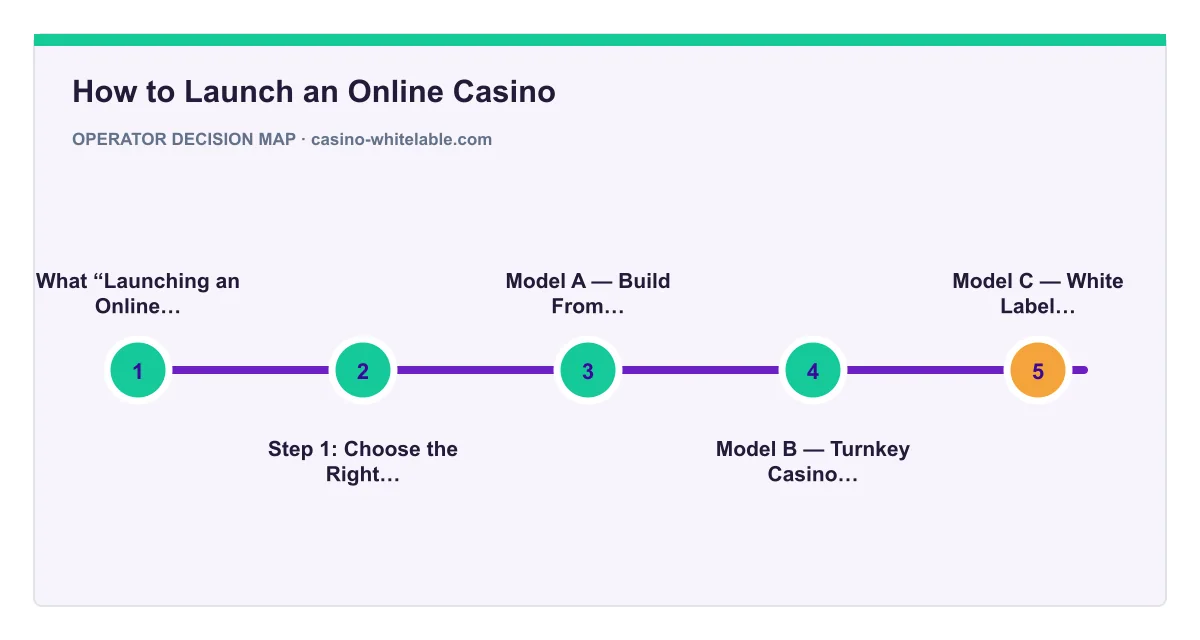
Launching an online casino is a regulated, high-risk online business project. Success depends less on “putting games on a website” and more on building a compliant operating system: licensing scope, KYC/AML workflows, responsible gambling controls, payment reliability, security, and a scalable platform that can survive audits, chargebacks, and growth.
This guide explains how to launch an online casino from a practical operator perspective: which model to choose, what regulators and payment providers typically check, how to structure the technology stack, and what usually causes delays. Where requirements differ by market, the article highlights decision points rather than giving one-size-fits-all claims.
Modern operators typically rely on specialized infrastructure such as iGaming platform solutions and enterprise-grade casino software to ensure operational stability and regulatory compliance.
What “Launching an Online Casino” Really Means
In practice, launching an online casino means you are ready to operate a real-money digital service with:
- A legal basis to offer gambling (your own licence or a compliant operating arrangement with a licensed entity)
- A controlled player lifecycle (registration, verification, risk scoring, limits, monitoring, support, and dispute handling)
- A payments and wallet system that supports deposits, withdrawals, reconciliation, and fraud controls
- A game content layer (providers/aggregation) with stable integrations and reporting
- Operational tooling (back office, analytics, CRM, bonus engine, and monitoring)
- Security and data governance (access control, logging, incident response, privacy management)
If one of these layers is weak, you may still “go live”, but the business often fails at onboarding, payments, compliance checks, or retention.
Step 1: Choose the Right Launch Model
Most new operators choose one of three models. The right decision depends on your timeline, available expertise, target markets, and the degree of control you need.
Model A — Build From Scratch
Best for: teams with strong engineering and compliance resources, long runway, and a clear multi-market plan.
- Maximum control over architecture, UX, and integrations
- Higher cost and longer time to market
- More responsibility for security, compliance tooling, and ongoing maintenance
Model B — Turnkey Casino Solution
Best for: operators who want speed but still require more control than typical white label packages.
- Platform and back office are ready, integrations are mostly prebuilt
- You still need a clear compliance plan and a realistic payments strategy
- Faster to launch than custom build, more flexible than pure white label
Many businesses choose a turnkey casino solution because it provides ready infrastructure while still allowing customization and brand control.
Model C — White Label Casino
Best for: first launches where speed, reduced technical risk, and operational support matter most.
- Platform, game content integrations, and back office come pre-configured
- Lower initial engineering burden, quicker go-live
- Trade-off: less control over core systems and provider choices
Many startups rely on white label casino solutions to launch quickly without building complex infrastructure from scratch.
If you are new to the industry, understanding what a white label casino is can help determine whether this model fits your business goals.
Step 2: Define Your Licensing & Market Scope Early
Licensing is not just “a document”. It defines what you can offer, where you can market, what player protection tools you must run, what reporting you must produce, and which payment providers will work with you.
What usually gets checked
- Player verification approach: identity checks, age checks, ongoing monitoring
- AML controls: risk scoring, suspicious activity processes, reporting readiness
- Responsible gambling: limits, self-exclusion, cooling-off, reality checks
- Security posture: access control, encryption, logging, incident response
- Operational capability: dispute handling, player support, transparency
Practical rule: define markets and payment providers before finalizing the platform architecture.
Step 3: Build a Platform Stack That Can Pass Audits
A modern online casino platform consists of multiple integrated systems that must work together seamlessly.
| Component | What it does | Common failure mode |
|---|---|---|
| Player account system | Registration, authentication | Weak access control |
| Wallet & ledger | Balances and transactions | Ledger inconsistencies |
| Payments layer | Payment processing | High decline rates |
| Game aggregation | Provider integrations | API instability |
| Back office | Analytics and CRM | Lack of operational visibility |
| Compliance tooling | KYC / AML controls | Audit failure |
Operators typically rely on scalable casino API integration systems to connect multiple game providers through a unified interface.
Step 4: Integrate Game Providers the Smart Way
Game variety drives player engagement and retention.
- Slots
- Table games
- Live dealer games
- Jackpot games
- Instant win games
Stable integrations and consistent reporting between providers are essential for reliable casino operations.
Step 5: Payments & Wallets — Where Most New Casinos Win or Lose
| Payment type | Deposits | Withdrawals | Operational note |
|---|---|---|---|
| Cards | Instant | 1–5 days | Chargeback risk |
| E-wallets | Instant | Minutes–24h | Fast payouts |
| Crypto | Minutes | Minutes–24h | Global access |
| Bank transfer | 1–3 days | 1–5 days | Large payouts |
Step 6: Mobile Experience Is Not a “Nice to Have”
Mobile devices generate the majority of casino traffic worldwide. Platforms must therefore support a fully optimized mobile environment.
Using a dedicated mobile casino platform ensures stable gameplay and optimized navigation across smartphones and tablets.
Step 7: Compliance Baseline
- KYC verification
- AML monitoring
- Responsible gambling tools
- Data protection
- Security monitoring
Estimated Timeline — What Drives Launch Date
| Stage | Scope | Delay risks |
|---|---|---|
| Business planning | Market research | Unclear strategy |
| Platform selection | Vendor evaluation | Wrong provider choice |
| Licensing | Regulatory approval | Documentation gaps |
| Payments onboarding | PSP integration | Risk checks |
| QA testing | Security and performance | Technical issues |
Advantages of White Label Platforms
- Faster launch
- Lower development cost
- Integrated infrastructure
- Prebuilt payment and game integrations
- Operational support
Conclusion
Launching an online casino requires careful planning, compliance readiness, and reliable technology infrastructure.
By selecting the right operational model, integrating secure payment systems, and relying on professional casino platforms, operators can enter the rapidly growing iGaming market with a sustainable business foundation.
Choosing the right casino software and platform architecture significantly improves launch speed and long-term scalability.
