

 Evgenii Iudin
 Updated March 2026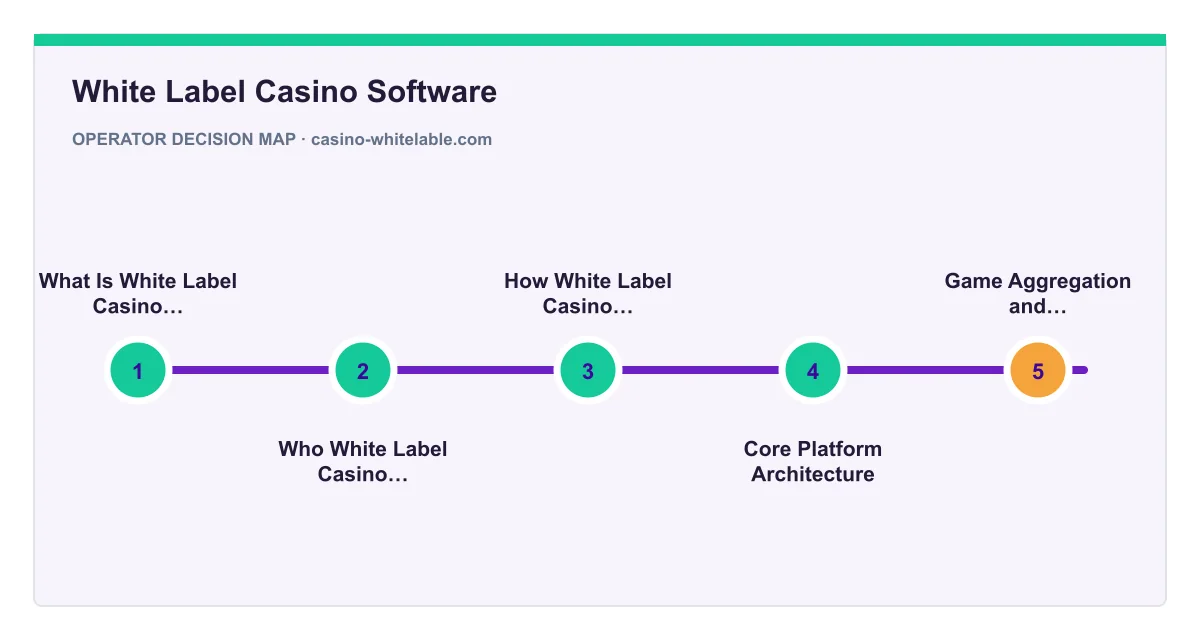
Definition: White label casino software is a ready-to-launch iGaming platform that enables a business to operate an online casino brand using pre-built infrastructure, pre-integrated game content, payment connectivity, and operational back-office tools delivered by a platform provider.
Last updated: March 8, 2026
Written by: iGaming Research Team
Reviewed by: Compliance Editor (Payments & Responsible Gambling)
Note: This page is informational and describes common platform models. Licensing, payments, and responsible gambling requirements depend on jurisdiction and partners.
What Is White Label Casino Software
White label casino software is a complete technology framework used to run an online casino. In most implementations it includes a player account system, wallet and transaction logic, game integrations, payment connectivity, reporting, bonus and promotion tooling, and an administrative dashboard.
The term white label typically describes a model where a provider supplies a production-ready platform and maintains core infrastructure and updates, while the operator launches under its own brand and focuses on marketing and operations.
For businesses exploring the broader model, it can also be useful to understand how a white label casino operates within the iGaming ecosystem and how responsibilities may be divided between provider and operator.
Who White Label Casino Software Is For
This model is often suitable for teams that want a faster launch using an established platform stack and can meet licensing, payments, and compliance requirements.
It may not be suitable for projects that require full platform ownership, deep technical customization, or complete control over backend architecture.
How White Label Casino Software Works
Core Platform Architecture
A white label casino platform usually relies on a centralized backend that manages player profiles, authentication, wallet logic, bonus systems, reporting, and operational monitoring.
Operators access these functions through a back-office dashboard that provides player management tools, analytics, and configuration options.
Game Aggregation and Content Delivery
Most platforms connect to game studios through an aggregator integration. This allows casinos to access a large catalog of slots, table games, and live dealer titles.
Many operators review the ecosystem of casino game providers when evaluating content availability.
Payment Connectivity and Transaction Workflows
Deposits and withdrawals are usually integrated through payment gateways and PSP partners. These integrations allow the platform to communicate with payment processors through secure APIs.
Many platforms implement payment connectivity through systems such as casino API integration to standardize transaction workflows.
Key Components of White Label Casino Software
- Player account management
- Wallet and transaction systems
- Game integration layer
- Payments connectivity
- Security and fraud monitoring
- Responsible gambling controls
- Administrative dashboard
These systems combine to create a fully functional online casino platform.
Regulatory and Compliance Baseline
White label software simplifies technical delivery but does not remove regulatory obligations. Operators still need clear compliance processes covering player verification, transaction monitoring, and responsible gambling.
| Provider typically handles | Operator typically responsible for |
|---|---|
| Platform infrastructure | Licensing approvals |
| Software updates | Responsible gambling policies |
| Technical integrations | Compliance monitoring |
| Back-office tools | Customer support operations |
Benefits of Using White Label Casino Software
- Faster launch time
- Lower engineering investment
- Pre-integrated game providers
- Built-in payment infrastructure
- Technical maintenance handled by provider
Because the platform infrastructure already exists, operators can focus more on marketing strategy, player acquisition, and customer experience.
Businesses often compare this model with a turnkey casino solution before selecting their launch strategy.
Trade-Offs and Risks
- Limited platform customization
- Dependence on the provider’s roadmap
- Possible vendor lock-in
- Payments and compliance responsibilities remain with the operator
Understanding these limitations helps operators choose the correct operational model for long-term growth.
White Label Casino Software vs Custom Development
| Feature | White Label | Custom Platform |
|---|---|---|
| Development time | Weeks | Months+ |
| Initial cost | Lower | High |
| Control | Moderate | Full |
| Maintenance | Provider | Operator |
How to Choose a White Label Casino Software Provider
- Licensing structure
- Game catalog
- Payment integrations
- Security and uptime reliability
- Commercial terms
Operators should also review the wider landscape of casino software providers before making a final decision.
FAQ
What is white label casino software?
White label casino software is a ready-made iGaming platform that allows operators to launch an online casino using existing infrastructure.
Who is responsible for licensing?
The operator usually remains responsible for licensing and regulatory compliance.
How much does white label casino software cost?
Costs depend on the provider, licensing model, and platform integrations.
Is white label casino software secure?
Most platforms include security systems such as encryption, fraud monitoring, and access controls.
How long does it take to launch?
Many casinos can launch within several weeks depending on compliance approvals.
Final Thoughts
White label casino software provides one of the fastest paths to launching an online casino brand. Instead of building technology from scratch, operators can use an established infrastructure maintained by a platform provider.
However, successful operation still requires strong compliance processes, reliable payment infrastructure, and responsible gambling controls.
