

 Evgenii Iudin
 Updated July 2026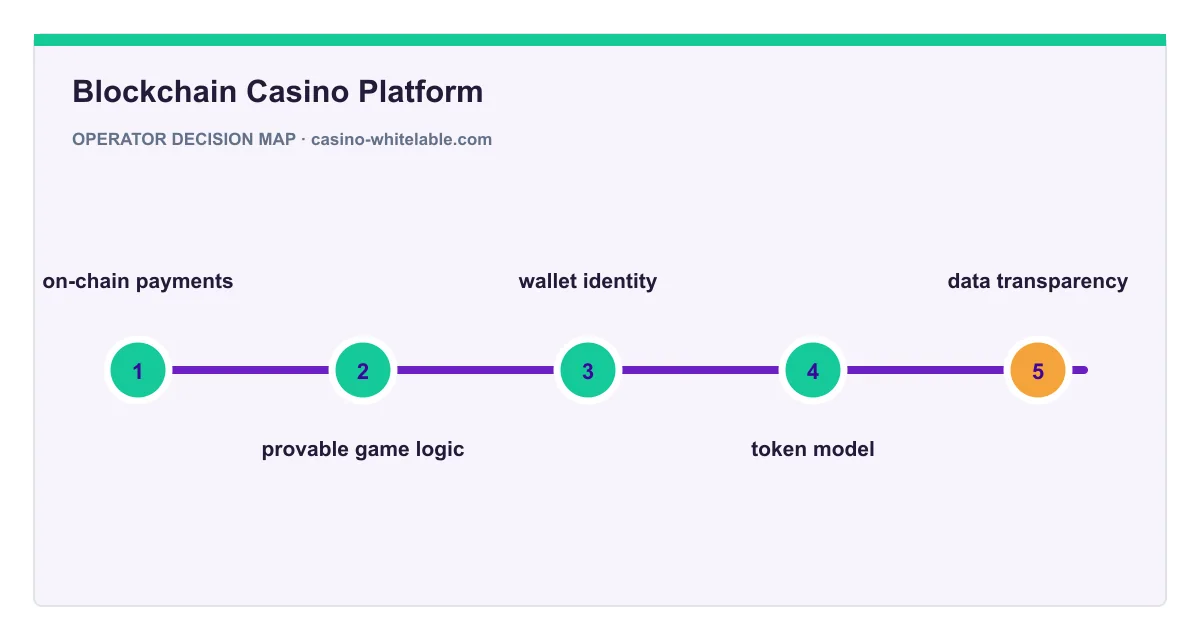
Decision in brief
Separate useful blockchain components from claims that do not improve casino operations. The useful comparison is not the longest feature list. It is the combination of operator fit, verifiable evidence, implementation ownership, measurable service levels, and a workable exit path.
What this guide covers
Separate useful blockchain components from claims that do not improve casino operations. It is written for crypto founders, ctos, investors, and product teams. The goal is to turn an early market question into requirements that a buying team can verify during discovery, demos, technical review, commercial negotiation, and implementation planning.
This site covers launch formats and operating responsibilities. Generic casino product-stack comparisons belong on casinos-software.com.
| Area | Evidence to request | Decision owner |
|---|---|---|
| on-chain payments | Request current documentation or a live workflow showing how on-chain payments is configured, monitored, exported, and supported in production. | Product / operations |
| provable game logic | Request current documentation or a live workflow showing how provable game logic is configured, monitored, exported, and supported in production. | Technology / compliance |
| wallet identity | Request current documentation or a live workflow showing how wallet identity is configured, monitored, exported, and supported in production. | Product / operations |
| token model | Request current documentation or a live workflow showing how token model is configured, monitored, exported, and supported in production. | Technology / compliance |
| data transparency | Request current documentation or a live workflow showing how data transparency is configured, monitored, exported, and supported in production. | Product / operations |
Evaluation checkpoints
1. Confirm ownership and operator control of on-chain payments
Define the expected outcome, request proof from the current product, record exceptions, and assign an owner for acceptance.
2. Test integration and data access for provable game logic
Define the expected outcome, request proof from the current product, record exceptions, and assign an owner for acceptance.
3. Review compliance and audit evidence for wallet identity
Define the expected outcome, request proof from the current product, record exceptions, and assign an owner for acceptance.
4. Put commercial assumptions and exceptions in writing
Define the expected outcome, request proof from the current product, record exceptions, and assign an owner for acceptance.
Implementation sequence
- Define scope and exclusions. Document the operator profile, target market, delivery model, required integrations, and responsibilities that cannot be outsourced.
- Collect comparable evidence. Use the same scenarios and data requests for every candidate. Separate shipped capability from roadmap commitments.
- Run a solution and risk review. Trace critical workflows across product, technology, payments, compliance, operations, finance, and support.
- Convert findings into acceptance criteria. Put dependencies, owners, service levels, data access, timelines, and remedies into the implementation plan and contract.
- Plan controlled go-live and exit. Test degraded modes, reconciliation, incident escalation, rollback, data export, and transition support before production launch.
Questions to put in the RFP
- Show the production workflow and documentation for on-chain payments. Which parts are standard, configurable, third-party, or roadmap-only?
- Show the production workflow and documentation for provable game logic. Which parts are standard, configurable, third-party, or roadmap-only?
- Show the production workflow and documentation for wallet identity. Which parts are standard, configurable, third-party, or roadmap-only?
- Show the production workflow and documentation for token model. Which parts are standard, configurable, third-party, or roadmap-only?
- Show the production workflow and documentation for data transparency. Which parts are standard, configurable, third-party, or roadmap-only?
- Which operator teams and external suppliers must participate in implementation, testing, and ongoing operation?
- Which data can the operator access in real time, export in bulk, and retain after termination?
- Provide measurable service levels, escalation paths, maintenance rules, and recent incident examples relevant to this scope.
Red flags
- A broad feature claim without versioned documentation or production evidence.
- An integration dependency with no named owner, test plan, or service level.
- Commercial terms that hide third-party fees, minimums, or transition cost.
Frequently asked questions
What should a buyer verify first when evaluating blockchain casino platform?
Start with the operating model and the evidence behind on-chain payments. A feature list is not enough: confirm ownership, configuration limits, implementation dependencies, and the exact production version being offered.
Which teams should review blockchain casino platform?
Crypto founders, CTOs, investors, and product teams should review the decision together. Product fit, technical feasibility, compliance accountability, commercial terms, and day-to-day operations are connected and should not be approved in isolation.
How should vendor claims be compared?
Use the same requirement matrix, evidence standard, and scoring scale for every vendor. Mark unsupported, roadmap-only, or market-specific claims separately instead of treating them as available capability.
What belongs in the contract or implementation plan?
Document scope, acceptance evidence, dependencies, owners, service levels, data access, change control, and exit support. Any requirement tied to data transparency should have a named owner and testable acceptance criterion.
